
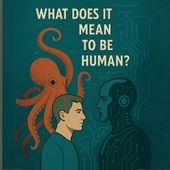
The central question I kept in mind while writing Tide Song was “What does it mean to be human?” This question was relevant to both the non-human Kopri, as well as to the Koro-Kah, who viewed people from other cultures as less than human.
With the rise of AI machine ‘intelligence,’ this question appears increasingly important. But the truth is, our species has been asking this question for tens of thousands, if not millions of years. “If you are part of my tribe, you are human. But if you are from a different tribe, you are less than human and it’s fine if my tribe kills you, takes your stuff, or enslaves you.” This question was even enshrined in the U.S. constitution, which defined black enslaved persons as only 3/4 of a person and not really human at all.
As you read Tide Song, keep these questions in mind. Are the Kopri “human,” meaning do they have the same value as members of the homo sapiens species? Does it matter to you that this story was created by a flesh and blood person, not some computerized prompt? What matters to you as a reader? Being mindlessly entertained by a steady stream of words that carries you along on standardized prose manufactured to the most common literary denominators, or gaining insight into another person’s mind.
Ask yourself: do I want the blandness of machine precision, or the glory of the human mind, with all its mistakes and imprecision. Machine written prose never makes a mistake. Only a human author’s work is perfectly imperfect with the occasional oddity of expression and misshaped grammar which define an author’s writing style.
So what will it be tonight: a fast food value meal or a five course dinner served up from an author’s imagination?